


TitanWell® - Nonstick Skillet
TitanWell® - Nonstick Skillet
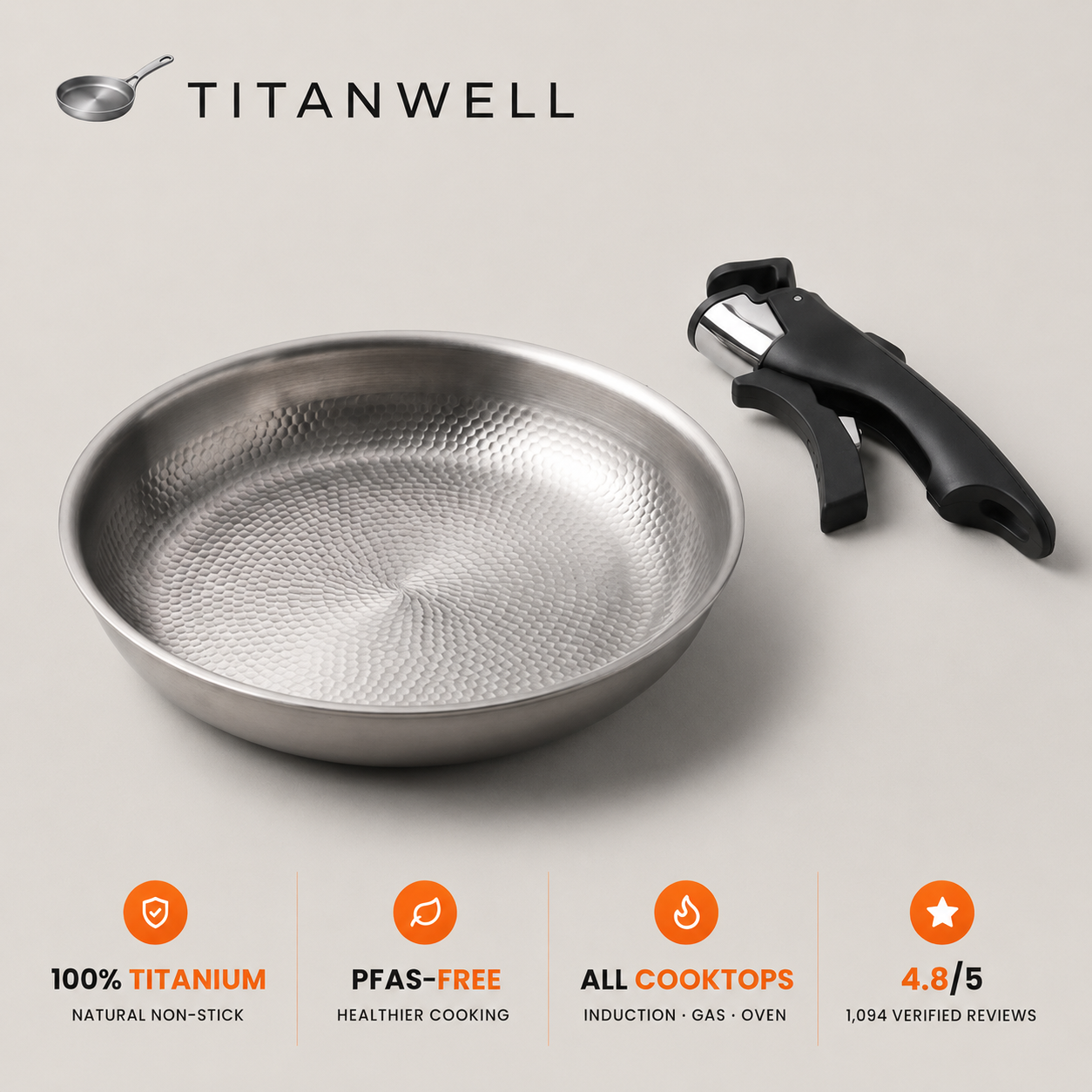
No chemical coating: cook with complete peace of mind.
Naturally non-stick: food does not stick.
Ultra-durable: scratch-resistant and built to last.
Compatible with all cooktops: induction, gas, ceramic, and oven.
Couldn't load pickup availability

TitanWell® - Nonstick Skillet
Non-toxic materials
Non-toxic materials
We design safe, non-toxic kitchenware made without harmful chemicals that could leach into food or the environment. Because you and your family should be able to use your kitchenware with confidence and cook with peace of mind.
Our products are free of the following substances:
✕ PFAS (“forever chemicals”)
✕ PTFE (Teflon)
✕ PFOA
✕ Lead and cadmium
✕ Nanoparticles
✕ Heavy metals
Free shipping with tracking
Free shipping with tracking
Your order is carefully prepared and then shipped with a personal tracking number.
Delivery time: 7 to 12 days.
A confirmation email will be sent to you as soon as your order is shipped.
It may take 48 to 72 hours for the tracking information to become available.
Delivery times may vary slightly depending on the time of year and the delivery area.
24/24H Customer support
24/24H Customer support
Our team is available to answer your questions and assist you before and after you place your order.
Description and use
Description and use
1. Product Use / Recommendations:
Designed for everyday use, the TitaneWell® skillet makes cooking simple, healthy, and easy to control.
Less Fat
Thanks to its naturally nonstick surface made of pure titanium, the TitaneWell® skillet requires much less fat than a conventional skillet.
The hammered texture distributes oil evenly, creating an extremely thin film between the surface and the food.
Ideal Temperature
Titanium heats up quickly and evenly:
Low to medium heat: sufficient for 95% of cooking tasks. Food doesn’t stick, nutrients are better preserved, and cooking is easier to control.
High heat: useful only for searing meat or enhancing the Maillard reaction.
Before first use
Wash the pan, heat it for a few moments over medium heat, then add a light drizzle of oil before cooking to optimize titanium’s natural nonstick properties.


Recommended by the Press


Trustpilot reviews
Excellent 4.8 / 5

Cook healthy meals without chemical coatings
The TitanWell skillet is designed without a chemical coating, for healthier everyday cooking.
No fragile coating that wears away over time.
Pure titanium helps preserve the flavor of your food and allows you to cook with little fat, with complete peace of mind.

A reliable skillet, built to last
Sturdy and durable, the TitanWell skillet is designed for everyday use.
It can be used with metal utensils and maintains its performance over time.
Compatible with all heat sources, including induction and the oven, it’s also easy to clean after each use.
Reviews of the week
-

I was looking for a pan without a chemical coating, and this one meets my expectations. It's sturdy, a pleasure to use, and works very well on an induction cooktop. It makes cooking a more relaxing experience.
-

Excellent quality. I cook meat, vegetables, and eggs without any problems. It stays in perfect condition!
-

Even on medium heat, everything cooks evenly! And visually, the searing marks are just gorgeous!
-

The skillet matches the description. It heats up quickly, cooks evenly, and is easy to clean. You can tell it’s a high-quality product.
-

I've been using this skillet for several weeks now, andit's great! It cooks perfectly, and food doesn't stick when you preheatit. Cleaning it is quick and easy.
-

Overall, it's a very good skillet. It takes a little while to get used to the temperature at first, but once you get the hang of it, the results are very satisfying.
-

It's so great! And I'm actually pretty picky when it comes to cooking!You can tell it's not just a “disposable” pan.


TitanWell®, a brand with character
Your kitchen deserves better
The right gear ist he kind your each for every day without even thinking about it. And the kind you never replace.
Frequently Asked Questions
How does the TitanWell prevent food from sticking without a chemical coating ?
How does the TitanWell prevent food from sticking without a chemical coating ?
Traditional pans cause food to stick because their coating wears down, gets scratched, and eventually peels off after a few months. The TitanWell works differently.
Its cooking surface is made of titanium—a dense, durable, and heat-stable material. No chemical coating that flakes off. No Teflon leaching into your food.
The nonstick properties are what’s known as “physical”: they rely on the right cooking temperature and a light drizzle of oil. Once the pan is hot enough (when a drop of water forms beads that roll off), your eggs, fish, and meat will slide right off.
This is the technique pros have always used—with no chemicals coming between you and your food.
Does the TitanWell contain PFAS, PTFE, PFOA, or other harmful substances ?
Does the TitanWell contain PFAS, PTFE, PFOA, or other harmful substances ?
No. None.
The TitanWell contains no chemical nonstick coatings—no PTFE (Teflon), no PFOA, and no PFAS. None of the substances your current pan may be releasing every time you cook.
Its interior surface is made of titanium, a material known for its stability and neutrality. What you cook in your pan stays on your plate—nothing else.
If you’re cooking for your family, that’s probably one of the reasons you’re here. You’ve come to the right place.
Does the TitanWell work on induction, gas, and all types of cooktops ?
Does the TitanWell work on induction, gas, and all types of cooktops ?
Yes, without exception.
Induction, gas, glass-ceramic, electric—the TitaneX is designed to work on all types of home cooktops. Its three-layer composite steel construction ensures even heat distribution, no matter what kind of cooktop you have.
No need to adjust your cookware. You can use it just like your other pans, with no unpleasant surprises.
How long does a TitanWell really last compared to a traditional skillet ?
How long does a TitanWell really last compared to a traditional skillet ?
Let’s do the math together.
A standard nonstick pan—even a “name brand” one—typically lasts between 12 and 24 months before the coating starts to peel off. Then you replace it. And the cycle starts all over again.
The TitanWell has no coating that wears out. Its titanium surface is designed to last for years, not months. No flaking coating, no sudden blackening, no strange tastes that develop.
If you’ve been buying a new pan every 18 months for the past 5 years, you know exactly how much that costs. The TitanWell is the opposite: you buy it once. And you’re done.
How do I use the TitanWell on a daily basis (first use, cooking, maintenance) ?
How do I use the TitanWell on a daily basis (first use, cooking, maintenance) ?
few simple steps—once you get the hang of them, you won’t even have to think about them.
1. First use (5 minutes, just once)
Rinse the pan and dry it. Heat it for 20 seconds over high heat. Add 2 tablespoons of oil, coating the entire surface. Rub a few lettuce or cabbage leaves over the pan with a spatula. Rinse and dry. Ready to go.
2. Day-to-day use
Always preheat the pan before adding oil (medium heat is sufficient). When a drop of water forms beads that roll off, it’s ready. Pour in the oil, then add the food. Avoid heating the pan empty for too long.
The trick that makes all the difference: once the food is in the pan, let it cook without moving it. When it comes into contact with a hot surface, the proteins will briefly stick—this is normal. Let it cook. After a few moments, the food will release on its own. That’s when you should flip it.
3. After cooking
A quick wipe with a sponge and a little lukewarm water. That’s all. Dishwasher safe. If white spots appear, that’s normal—a splash of vinegar or lemon juice will make them disappear.
A word of advice: eggs, fish, and meat require the right temperature and a little patience. The complete guide comes with the pan.